How we use “value engineering” to build your perfect new deck.
Building a deck from the ground up gives us total control. We have the power to design for maximum efficiency from the first post hole to the final railing cap. But to unlock that efficiency, effective new deck budget planning requires one crucial input — your target number.
The honest truth about budgets
At Deck Guardian, we don’t treat your budget as a target to hit, but as a structural specification — just like the dimensions of your yard. It is the data point that allows us to “value engineer” the project.
When we know your financial parameters upfront, we stop guessing and start optimizing. We filter through thousands of material and layout combinations to find the one configuration that maximizes quality while strictly respecting your bottom line.
Here is how sharing your target number allows us to optimize your new deck.
1. The “16-foot” cost cliff
When building a new structure, size dictates engineering.
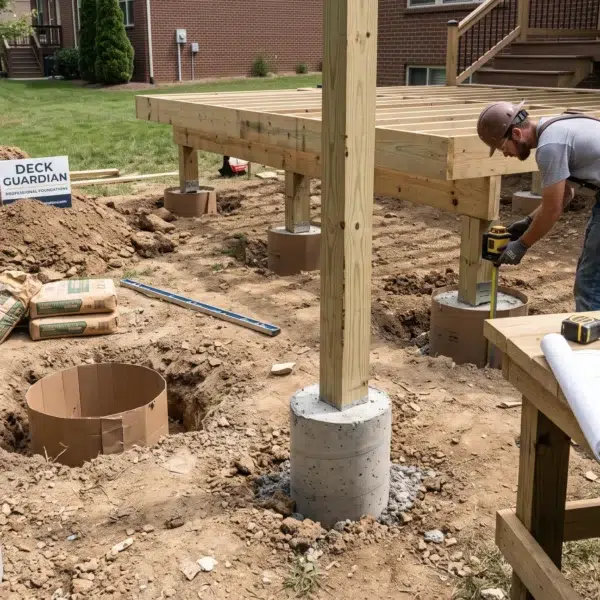
- The cost driver: Most building codes require an entirely new row of concrete footings and a support beam if a deck extends more than 16 feet from the house.
- The fix: If you request a 17-foot deep deck, you pay for massive excavation and concrete for just one foot of space. If we know your budget, we design a 16-foot deck. You get virtually the same space, but save thousands on structural labor.
2. Zero-waste dimensions
Deck boards come in standard lengths of 12′, 16′, and 20′.
- The cost driver: Designing a 13-foot wide deck requires buying 16-foot boards and cutting 3 feet off every single one. That is 20% of your material budget going into the trash.
- The fix: We design dimensions to match standard lumber lengths exactly. A 12′, 16′, or 20′ wide deck means zero waste. Every dollar stays on your deck.
3. Matching materials to your wallet
Materials define both the look and the longevity of the project.
- The cost driver: The price gap between pressure-treated wood and premium composites is significant.
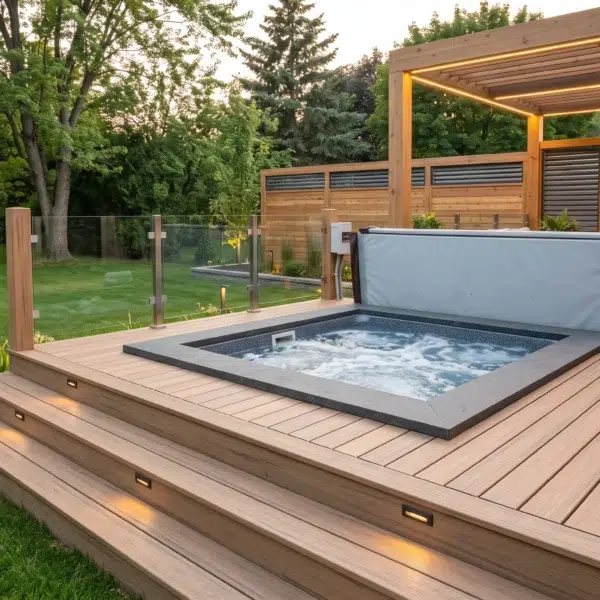
- The fix: We guide you to the “sweet spot” of value. We recommend high-performing, cost-effective options — like Deckorators composite or RDI Finyl Line railings — that provide essential features like fade and slip resistance without the luxury markup.

4. Layout Logic: perpendicular vs. diagonal
The orientation of floorboards changes the framing underneath.
- The cost driver: Diagonal decking looks stylish, but requires support joists to be spaced closer together (12 inches apart vs. 16 inches). This increases treated lumber costs and decking waste.
- The fix: A perpendicular layout is the most efficient. Knowing your budget helps us decide: pay for the diagonal aesthetic, or save that money for high-end railings?
5. Smart step placement
Steps are a major labor cost often overlooked.
- The cost driver: Curved or flared stairs require intricate custom framing.
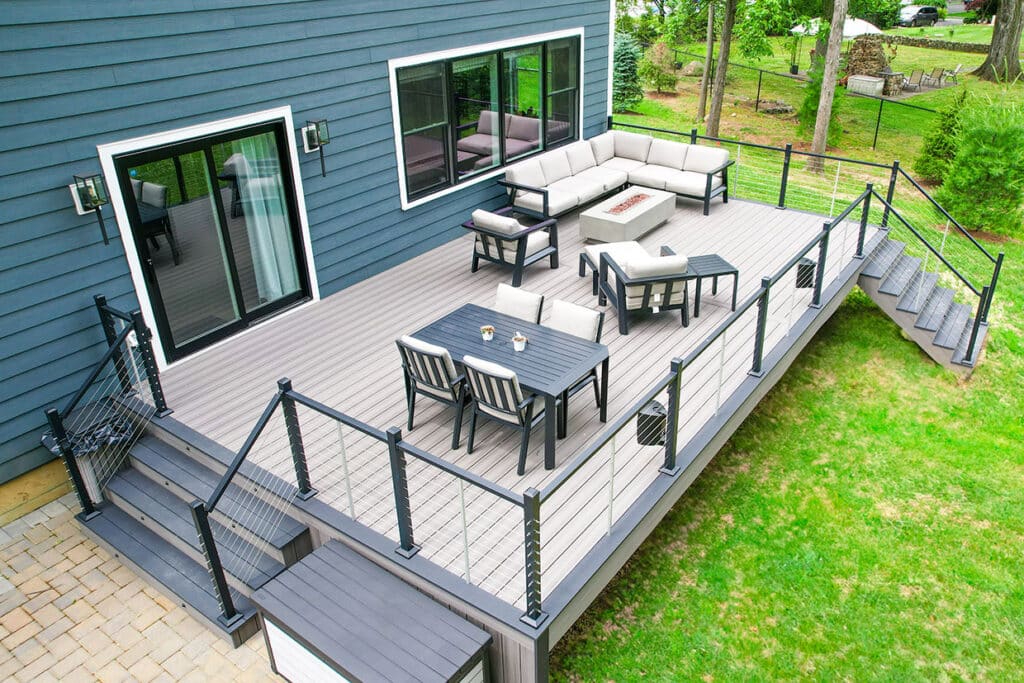
- The fix: Straight steps are the “MVP” of savings. They install faster and use less lumber. By aligning them with standard 6-foot or 8-foot railing sections, we also eliminate “dead zones” in the railing layout, ensuring you don’t pay for custom carpentry you don’t need.

6. Shape complexity
Rectangles are efficient; curves are labor-intensive.
- The fix: “Simple” doesn’t mean boring. If we know your budget, we can design a highly efficient rectangular footprint but use the savings to upgrade the materials — giving you a luxury look on a standard frame.
7. Strategic phasing
New builds require many components: barriers, skirting, lighting, etc.
- The fix: We distinguish between “Day One” needs and future upgrades. If the budget is tight, we install the wiring for lights now (cheap) and let you buy the actual fixtures next year. We ensure the core is built to last.

8. Creative financing
Sometimes the right size deck is slightly larger than your cash on hand.
- The fix: We offer financing or split-payment structures. This allows you to build the correct size now — one you won’t outgrow — while managing cash flow comfortably.
The bottom line
Your budget acts as the primary filter for our design process. It enables us to bypass inefficient layouts and immediately select the footprint and materials that yield the highest return on your investment. Let’s collaborate to build a custom deck that perfectly aligns with your financial goals.
Ready to break ground? Reply to this email to start the conversation, or contact us to discuss how we can maximize your budget.