Table of Contents
ToggleDeck railing code feels like a small detail until a commercial deck project reaches review, inspection, or daily use. Then it becomes clear fast: business decks are not planned the same way as residential decks.
At Deck Guardian, railing is not treated as decoration added after the deck surface is chosen. Commercial deck railings matter most when the space is actually being used. People move through it, gather near edges, use stairs, and rely on the railing without thinking about it. That is why fall protection, traffic flow, stair safety, accessibility, liability, and inspection approval all depend on the right system. A shared deck cannot be treated like a private backyard deck.
At the most basic level, deck railings serve one purpose: to prevent accidental falls. But commercial railings have to do more than satisfy the obvious rule. They also need to address specific safety concerns tied to crowds, small children, wet shoes, furniture movement, stair traffic, weather, and repeated use from people who are only visiting, renting, working, or passing through.
That is why commercial decks need different planning from the start.
How Deck Height Shapes Deck Railing Height Codes
Most deck railing height codes begin with the same basic trigger: height above grade. The International Residential Code gives the common residential baseline, and the International Residential Code (IRC) wording is often what owners see when they research guard requirements online.1 In many IRC-based situations, the standard code requires railings when residential decks higher than 30 inches above grade need guards, with a minimum height of 36 inches.
For commercial and multifamily properties, the planning usually starts from a stricter place. Commercial deck railing height is commonly 42 inches from the walking surface to the top rail. That extra height matters because shared spaces usually involve:
- more people using the deck at once;
- customers, tenants, staff, or guests moving through the space;
- crowds gathering near open edges;
- stair traffic and furniture movement;
- a higher safety responsibility for the property owner.
Deck height is still only one part of the review. A private home, condominium building, restaurant deck, and public-facing business patio may fall under different code requirements. Local building codes may also impose stricter requirements than the IRC, so local building authorities can add details beyond the model code.
This is why deck railing ideas that work for a private home cannot simply be copied onto a business property. The railing may look fine. It may still fail review.
Commercial Deck Railing Height vs 36 Inches: Not Just a Design Preference
There are practical and aesthetic reasons homeowners may want to build tall railings. On a standard deck, the recommended deck railing height may still follow the 36-inch residential baseline if local code allows it. Commercial decks usually start from a different point, since the minimum railing height is often already higher.
A home deck may commonly use 36 inches. In commercial or multifamily buildings, deck railings are often planned around 42 inches because shared spaces need more protection. Open-sided walking surfaces, balconies, elevated structures, and common deck areas see more people, more movement, and more responsibility.
Deck railing height should be measured straight up from the walking surface. It should not come from the side of the deck, the landscaping below, or the bottom rail. Stairs have a separate measuring method. Stair railings are often measured from the line connecting the stair nosing, and if the stair guard is also meant to function as a graspable handrail, it may need to stay in the 34- to 38-inch range.
That is one reason commercial railing systems need early coordination. A top rail that looks correct on the flat deck may not work on deck stairs. A particular railing configuration may need a separate handrail, adjusted post placement, or a different connection detail to meet code.
Code item | Common planning number | Why it matters |
Residential guard trigger | More than 30 inches above grade | Determines when guards are commonly required |
Residential deck railing height | 36 inches minimum | Common IRC-based guard height |
Commercial deck railing height | 42 inches minimum | Common height for commercial and multifamily use |
Guard opening limit | 4-inch sphere | Helps protect small children and prevent entrapment |
Stair handrail height | 34 to 38 inches | Measured from stair nosing line |
Guard load check | 200 lb concentrated load | Helps confirm structural strength at the top rail |
These numbers are planning references, not a substitute for permit review. The local building department always has the final say.
Building Codes Also Control Openings, Not Just Height
Railing height often gets most of the attention, but spacing can be just as important. Railing baluster spacing code commonly follows the 4-inch sphere rule. If a 4-inch sphere can pass through an opening in the railing assembly, the spacing may be a problem.
That check should not stop between the main balusters. It can apply to:
- spaces between balusters;
- gaps around vertical posts;
- openings near the bottom rail;
- infill areas created by cable, glass, or mixed railing systems;
- stair-related openings near treads and landings.
For baluster spacing, the IRC mandates that a 4-inch sphere should not fit between any two components of the railing assembly, including between balusters and posts. On stairs, the triangular space beneath the bottom rail and above the stair treads is treated differently and often must not allow a 6-inch sphere to pass.
These rules matter because small children interact with railings differently than adults. A railing that looks safe from a distance may still create an entrapment risk if the openings are too wide.
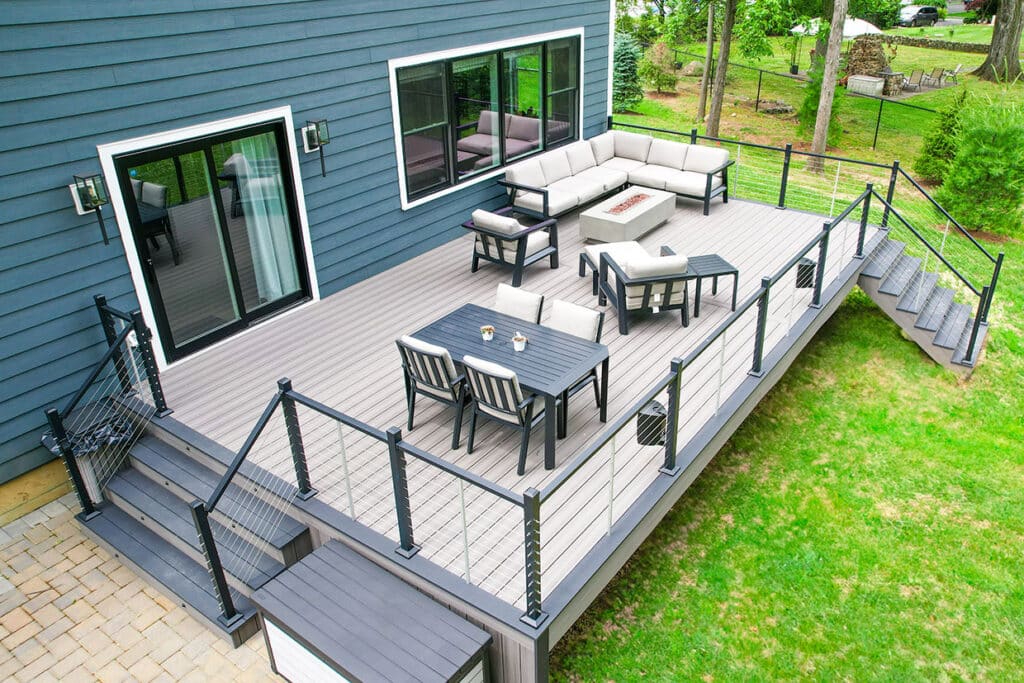
Cable and glass railing systems need special attention here. Cable railing can look clean and modern, but cable can flex under pressure if spacing, post placement, fittings, or tension are wrong. Glass panels may reduce openings, but the posts, clamps, edges, and mounting hardware still need to work as part of a complete code-compliant system.
Deck Stairs Can Change the Railing Plan Fast
Deck stairs are where many railing plans get more complicated. A flat deck guard is one thing. Stair railings, stair handrails, stair treads, stair nosing, landings, and transitions are another.
If deck stairs have four or more risers, a continuous, graspable handrail is commonly required. The handrail needs to be comfortable to hold, not just visually attractive. A wide flat top rail may work as a guard, but it may not qualify as a graspable handrail. That distinction can surprise owners who expected one rail to do everything.
Stair railings also need to coordinate with the rise and run of the stairs. The rail should follow the slope cleanly. The handrail height is measured vertically from the stair nosing line. The triangular space near the stair tread and bottom rail must be checked. Posts need to land where they can be properly supported.
This is where how code checks fit into the deck building process becomes important. If railing and stair details are checked late, fixes can affect framing, finishes, post locations, and inspection timing.
A commercial deck project should not wait until installation to solve the stair railing problem.
Code Requirements and Permits Matter More on Business Decks in Northwest NJ
Model codes matter, but specific building codes decide what actually gets approved.2 In New Jersey, a building permit for a deck project can depend heavily on the municipality reviewing it. Structural plans, deck placement, setbacks, property line limits, and site-specific conditions may all come into play.3 A local building department may also request amendments or details that go further than the basic deck railing height codes people usually find online.
For business owners, the permit package matters. Drawings may need to show deck height, railing height, post spacing, stair details, structural elements, and how the deck sits on the property. Local building authorities may also consider the purpose of the deck, including commercial applications, multifamily use, restaurant seating, or any other public-facing use.
Many deck owners focus first on materials: wood, composite, aluminum, steel, cable, or glass panels. Those choices matter, but permit review often starts with structure and safety. Can the railing posts resist load? Are the openings compliant? Is the deck surface high enough to require guards? Are open-sided walking surfaces protected? Are stair handrails correct?
That order is not glamorous. It is how projects avoid expensive corrections.
For commercial deck projects across Northwest NJ, Central Jersey, and nearby Pennsylvania service areas, this local review step matters even more. A deck in Somerset County, Morris County, Hunterdon County, Middlesex County, Bergen County, Bucks County, Montgomery County, or Chester County may be reviewed through a different local office, even when the general safety goals are similar. That is why Deck Guardian treats railing height, stair details, guard openings, and permit documentation as part of the planning process, not as last-minute field decisions.
A local commercial railing review may focus on:
- deck height above grade;
- railing height and guard placement;
- stair handrail shape, height, and continuity;
- baluster or infill spacing;
- post attachment and structural support;
- open-sided walking surfaces;
- site layout, setbacks, and property-specific conditions.
For business properties in Northwest NJ, this can matter on restaurant patios, shared tenant decks, clubhouse decks, office outdoor areas, and multifamily common spaces. These projects are not only about choosing a railing style. They often need early coordination between the deck design, stair layout, permit drawings, and the expectations of the local building office.
Why Low Decks Still Need Structural Planning
Decks lower than 30 inches above grade may not always require guards under common IRC-based residential guidance. That does not mean such a low height makes the project simple, especially in a commercial setting.
Deck owners choose railings on low decks for crowd control, accessibility, accent lighting, built-in benches, a wind or sound barrier, or to guide traffic away from landscaping, parking areas, and uneven grade. These choices are often practical, visual, and tied to how people actually move through the space.
But low does not mean simple. Even a deck surface close to grade needs stable framing, drainage, beam planning, post support, and safe transitions. That is why low decks still need structural planning, even when the maximum deck height does not trigger the same guard requirements as elevated structures.
A lower deck used by customers or tenants still carries responsibility. People may step backward, lean on railings, move chairs near edges, or walk the space in poor lighting. Even when guards are not the main code issue, railing or edge planning may still help with:
- guiding customer traffic;
- separating seating from steps or landscaping;
- improving visibility near changes in elevation;
- supporting lighting or screening;
- making the space feel more organized and intentional.
The code may be one part of the decision, but real use should guide the rest.
Deck Railing Systems: Materials Matter, But Code Comes First
Railing material matters, but it should not be the first decision. Wood, aluminum, steel, composite, cable, and glass can all work in the right setting. None of them automatically solves code requirements.
Each material brings a different planning issue:
- wood railings offer a traditional look, but they need maintenance to help prevent rot, decay, and movement;
- aluminum and steel can fit a more modern deck, but steel may need protection against rust;
- composite railings reduce maintenance and can still offer a wood-like appearance;
- cable railing can preserve views, but spacing, tension, and child safety need careful review;
- glass railing looks clean and open, but support, posts, clamps, and installation details matter.
Before choosing the final look, a commercial deck railing project should answer the harder questions:
- What is the deck height?
- Is the space residential, commercial, or multifamily?
- Are there open-sided walking surfaces?
- Will the owner need to build railings taller for added screening, visibility control, or shared-space safety?
- Will the railing need to hold accent lighting or signage?
- Are there deck stairs?
- Does the top rail also need to function as a handrail?
- Are local building codes stricter than the baseline?
Only after those questions are answered should the design conversation move into color, style, infill, and finish.
Professional Installation for Northwest NJ Commercial Deck Railings
Before crews install deck railings, a commercial deck railing must be planned to do more than look straight. It needs structural integrity, the right height, correct openings, secure posts, solid top rail connections, and proper attachment to the framing or deck surface.
That is why professional installation matters. The railing is there for safety, not just appearance. A good-looking railing that shifts when someone leans on it is a problem. Cable railing with openings that are too wide can be a problem too. So can a glass railing system with weak post mounting. And a stair rail that people cannot grasp properly may fail at the exact moment someone needs support.
Commercial deck railings also take more abuse than residential ones. Customers, tenants, staff, delivery workers, and guests all move through shared spaces differently than a homeowner moves across a private deck. That can mean:
- more contact with the top rail;
- more leaning near edges;
- more furniture movement;
- more stair traffic;
- more weather exposure;
- more liability if something feels loose, unclear, or unsafe.
That is why commercial railing planning starts earlier and checks more details before the work moves forward.
FAQ
What is the standard height for commercial deck railings?
Commercial deck railing height is commonly 42 inches, measured vertically from the adjacent walking surface to the top rail. Local building codes should always be checked.
When are deck railings required?
In many IRC-based residential situations, deck railings are required when the deck surface is more than 30 inches above grade. Commercial and multifamily projects may have additional rules.
What is the common residential deck railing height?
Residential deck railing height is commonly 36 inches for decks higher than 30 inches above grade, though some local building codes may require more.
What is the 4-inch rule for deck railings?
The 4-inch rule means required guards should not have openings that allow a 4-inch sphere to pass through. It is mainly intended to reduce child entrapment risk.
Do deck stairs need a separate handrail?
Deck stairs with four or more risers commonly require a continuous, graspable handrail. A guard top rail does not always qualify as a handrail.
Can commercial decks use cable railing systems?
Yes, cable railing systems can be used on commercial decks if they meet code requirements for height, spacing, tension, load resistance, and installation.
Do low decks need railings?
Decks lower than 30 inches above grade may not always require guard railings under common residential guidance, but railings may still be useful for safety, traffic control, or design.
Who decides the final railing requirements?
The local building department and local building authorities decide the final requirements for a project. Model codes are important, but local enforcement controls approval.