Table of Contents
ToggleA louvered pergola can be worth the investment if direct sunlight or rain regularly limits how you use your deck or patio. Its main advantages are adjustable shade, better airflow, and overhead rain protection. The disadvantages include higher installation costs, moving parts that require maintenance, and weather-related limitations. The right choice depends on how much flexibility you need and what the selected system can actually provide.
At Deck Guardian, we help homeowners in our New Jersey and Pennsylvania service areas plan outdoor improvements around their property and priorities. Before choosing a louvered pergola, consider how often you would adjust it, what protection you expect, and whether a simpler structure would meet your needs. The most useful comparison starts with everyday use, not the longest list of features.
Is a Louvered Pergola Worth It?
Start with the problem you want to solve. An outdoor dining area exposed to afternoon sun may benefit from adjustable louvers, while a seating area that already has comfortable shade may not justify the additional investment. Consider how frequently you would use the adjustable roof before comparing its advantages and limitations.
The main trade-offs are straightforward:
Advantages | Limitations |
Adjustable light and ventilation | More components to inspect and maintain |
Rain protection when properly closed | Performance depends on the system, drainage, and weather |
Manual or motorized operation | Motorized controls depend on power |
Modern architectural appearance | Higher upfront investment than simpler structures |
Judge long-term value by the comfort and functionality you expect to use. A promised increase in resale value should not drive the decision.
Louvered Pergola vs. Traditional Pergola
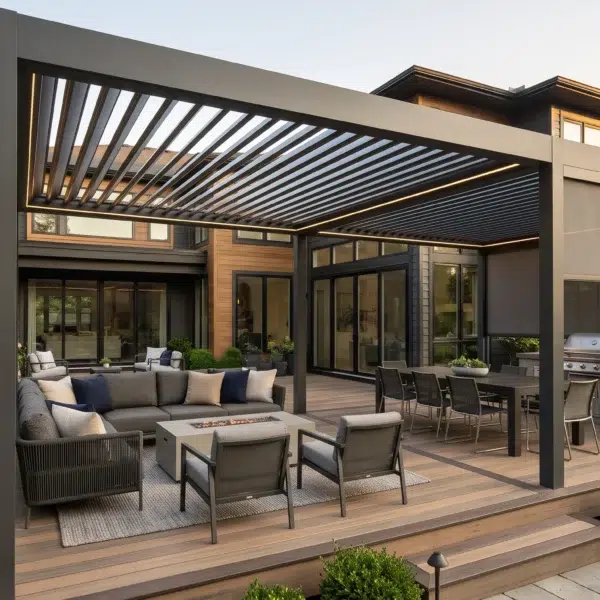
A traditional pergola has a fixed, open-beam roof. A louvered pergola uses movable louvers to adjust overhead coverage. That difference matters more than appearance when you are deciding what to install.
A traditional wood pergola may suit a rustic garden seating area where partial shade is enough. If you want climbing vines, ask whether its frame can support the additional weight. Its fixed roof does not provide the same adjustable coverage or rain protection as a closed louvered system.
Choose a louvered pergola if changing sunlight regularly makes your outdoor space uncomfortable. Consider a traditional pergola if you prefer a simpler structure and do not need movable overhead coverage. For visual inspiration after evaluating those practical differences, see our Pergola Louvers Ideas.
Louvered Roof Advantages: Adjustable Shade and Airflow
The strongest reason to choose a louvered pergola is control. You can angle the louvers to admit more sunlight or reduce direct exposure as conditions change.
Partially opening the adjustable slats may help hot air escape from beneath the roof. This gives you a way to balance shade and airflow rather than choosing between an entirely open roof and fully closed coverage.
Before ordering, discuss where shade is needed, when the patio receives full sun, and how you use the space. Ask how the proposed louvered pergola would affect light over your seating area and near the house. The useful question is whether its adjustment range works for your outdoor space, not whether the product has the widest advertised rotation angle.
A louvered pergola also introduces a modern architectural style. That aesthetic appeal is a benefit when it suits your home, but appearance alone does not resolve practical coverage needs.
Weather Protection Has Limits
A louvered roof can provide rain protection when its louvers are fully closed, within the selected system’s specifications. Proper drainage planning is essential to that performance.
Closed louvers may form a watertight seal, but wind-driven rain can still reach the space below. In New Jersey and Pennsylvania, verify the model’s wind and snow ratings and drainage requirements. The ASCE Hazard Tool provides location-specific weather hazard data, not product ratings.
Before buying a louvered pergola, clarify:
- How does the system collect and discharge rainwater?
- Are integrated gutters included?
- What wind and snow ratings apply to the exact configuration?
- What operating instructions apply during severe weather?
A louvered pergola may extend outdoor living opportunities, but overhead coverage alone is not a guarantee of year-round comfort. If you are comparing different ways to shelter your deck, explore our deck cover ideas for alternatives.
Manual or Motorized Louvered Pergola?
Manual pergolas suit a hands-on approach. At Deck Guardian, our motorized and automated louvered roof options include remote and app-based operation. Confirm which controls and override features your model includes.
Some louvered systems offer modern features such as smart sensors and home automation. Confirm which features are included in the proposed system and which require additional equipment.
During a power outage, motorized louvers may stop working. Ask whether the model offers a manual override.
Maintenance: Low Maintenance Still Requires Upkeep
An aluminum pergola can reduce some of the material upkeep associated with wood, but long-term durability still depends on the finish, hardware, and site conditions. Aluminum pergolas resist rust and corrosion effectively. Powder-coated aluminum does not absorb water or provide a food source for insects, while a wood pergola can be vulnerable to warping and rot.
However, the material is only one part of a louvered pergola. Louvers, drainage channels, and mechanical components still need attention. Debris can interfere with drainage and operation, so proper upkeep includes periodic inspection and cleaning.
Request the instruction manual before committing. Review the care requirements for the finish, moving parts, and gutters, including whether any work requires professional service. Louvered pergolas can last 15-25 years with proper care. Occasional cleaning should be part of an informed maintenance plan, not a substitute for one.
Louvered Pergola Installation and Costs for Outdoor Living Spaces
The louvered pergola cost should reflect the complete installation, not just the structure itself. Before accepting a quote, confirm:
- Project scope: Does the price include controls, drainage, electrical connections, and structural preparation? Check what’s excluded when comparing DIY kits with professional installation.
- Structural requirements: Have existing deck supports assessed, even for a lightweight outdoor structure. If attaching the pergola to your home, clarify anchoring and water management.
- Local approvals: Permit requirements vary across New Jersey and Pennsylvania. For NJ projects, review the state’s construction permit requirements and consult your local construction office.
Planning a new deck and pergola together? Explore our custom deck construction options before finalizing the layout.
At Deck Guardian, we review your property and project goals before providing a detailed quote and specification sheet. Confirm how the pergola will be constructed and anchored, along with its features, maintenance requirements, and warranty coverage.
Explore our Louvered Roofs service to discuss the right solution for your outdoor space.
FAQ
Does a Louvered Pergola Need a Permit in NJ or PA?
Permit requirements depend on the municipality, the structure’s design, and whether the pergola is freestanding, attached to a house, or installed over an existing deck. Louvered pergolas may require city permits or HOA approval. Check with the local construction office before ordering and confirm who will handle any required permits and inspections.
What happens to a motorized louvered pergola during a power outage?
Powered adjustment may be unavailable. Before ordering, confirm whether the specific model includes a manual override or another way to operate the louvers without electricity.
Can a louvered pergola be installed over an existing deck?
It may be possible, but the existing structure needs assessment. Ask your installer whether the deck can support the proposed system and whether reinforcement is necessary.
Will an Attached Louvered Pergola Reduce Daylight Indoors?
It can. A louvered roof installed near windows may affect how much natural light enters adjacent rooms, particularly when the louvers are closed. Review the proposed placement and roof orientation before installation to understand how the structure may change indoor lighting.