How Much Concrete Do I Need? A Deck Project Estimation Guide
Every sturdy deck begins with a strong foundation, and concrete plays a key role in making that happen. Whether you’re building concrete footings, concrete columns, or a concrete slab for a patio, you’ll need to calculate how much concrete your deck project requires for proper support and stability. Accurate measurements and the right materials ensure a safe, long-lasting deck.
A concrete calculator can be your best friend when simplifying this sometimes complex process. By inputting your project’s specific dimensions — such as footing diameter, depth, and number of deck footings — you can quickly determine how many bags of concrete or cubic yards of concrete are needed. This helps you avoid costly overbuying or frustrating shortages. For instance, knowing how many bags of concrete or how many cubic feet you require keeps your concrete cost within budget and your project on track.
Not only will Deck Guardian guide you through these calculations, but we’ll also cover basics about concrete mix, pouring slabs, and other concrete applications tailored for your deck project. Let’s get started so your new porch or deck starts on the right foundation!
Related Article — Why Your Dream Deck Starts with a Great Deck Plan

What’s the Difference Between Concrete and Cement?
You might hear “cement” and “concrete” used interchangeably. While related, they aren’t the same.
What is Cement?
Cement is a fine powder made primarily from limestone, clay, and iron ore. It acts as the glue in construction, binding materials together when mixed with water. Alone, cement isn’t strong or durable enough for structures — it’s just one ingredient in concrete.
What is Concrete?
Concrete is a mixture of cement, water, sand, and gravel (aggregates). When mixed, the concrete mix forms a strong slab or footing that hardens and supports decks, garage floors, walkways, patios, and more.
Concrete’s strength and durability depend on the right mix ratios and thickness. For example, concrete slab thickness varies with use: patios or sidewalks are typically 4 inches thick; garage floors or heavy driveways require 5–6 inches; commercial slabs may be 6–8 inches or thicker.
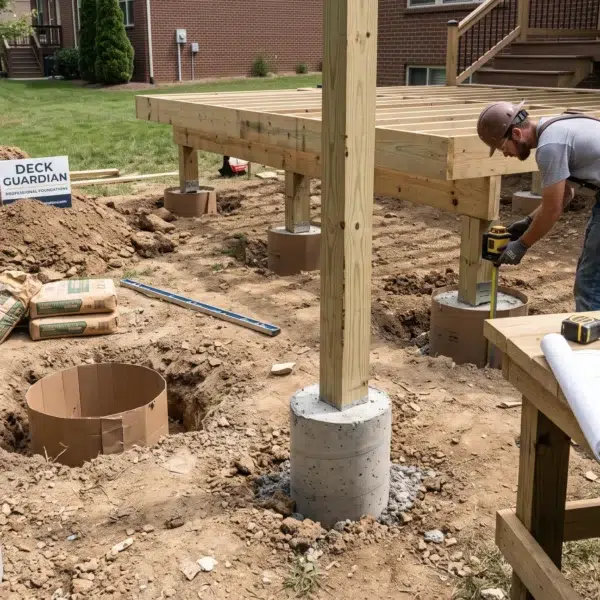
If you’re pouring a concrete slab or deck footings, mixing it correctly and calculating volume are crucial steps. This includes using the correct hole depth and ensuring proper reinforcement with rebar where needed.
How to Calculate the Volume of Concrete Needed
Estimating the volume of concrete needed for your project is key to avoid material waste or shortage.
Use an Online Concrete Calculator
The easiest way is by using a free concrete calculator tool available online. These calculators help you estimate volume in cubic feet or cubic yards and determine the number of bags of concrete needed.
Manual Calculation Steps
If you prefer manual math, follow these steps:
-
Determine Dimensions
Measure the length, width, and thickness/depth of your concrete slab or footing. For round footings, use the diameter and depth. -
Calculate Volume in Cubic Feet
Use the formula for slabs:Volume (cubic feet)=length×width×thickness
For round footings:
Volume (cubic feet)=π×(diameter2)2×depth
-
Convert Cubic Feet to Cubic Yards
Divide cubic feet by 27 (since 1 cubic yard = 27 cubic feet):Cubic yards=cubic feet27
-
Calculate Number of Bags
An 80-lb bag of concrete covers approximately 0.6 cubic feet. Divide total cubic feet by 0.6 to get the number of bags needed.
Example:
Suppose you have 8 deck footings, each 12 inches in diameter and 4 feet deep:
-
Calculate volume per footing in cubic feet:
3.14×(0.5)2×4=3.14×0.25×4=3.14 cubic feet
-
Total volume for 8 footings:
3.14×8=25.12 cubic feet
-
Number of bags:
25.12/0.6≈42 bags of concrete

Step-by-Step Guide to Mixing and Pouring Concrete
Step 1: Gather Tools and Materials
-
Bags of concrete mix (pre-measured for easy use)
-
Mixing container (wheelbarrow, bucket, or mixer)
-
Water source
-
Shovel or mixing tool
-
Gloves, safety goggles, dust mask
-
Forms or tubes for shaping slab or footings
Step 2: Prepare Forms
Ensure forms are level, aligned, and secure to avoid concrete spilling and achieve correct slab thickness or footing depth.
Step 3: Mix Concrete
-
For manual mix: gradually add water to concrete bags while stirring until the mix is a peanut butter consistency.
-
Electric mixers provide an easy mix for larger jobs.
Step 4: Pour Concrete
Pour carefully into forms, using a shovel to fill corners and edges evenly.
Step 5: Compact Concrete
Use rebar, stakes, or rods to poke and remove air bubbles, ensuring strength.
Step 6: Level Surface
Use a screed or trowel to make the top even with the form edges.
Step 7: Let Concrete Cure
Avoid disturbance for 24+ hours. Mist the surface in dry, hot weather to reduce cracking.

Tips for Concrete Success
-
Add water slowly — too much weakens the mix.
-
Keep your tools and forms ready — concrete sets fast.
-
Avoid pouring concrete in freezing or extreme heat conditions.
-
For large scale projects, consider ordering a cubic yard of concrete from a mixer truck — this is easier for volume accuracy and speed.
-
Mix extra concrete (5-10%) to fill any holes, errors, or overflows.
-
Using proper gravel, sand, and cement ratios provides a strong, durable slab or footing.
When planning your concrete deck footings, precise measurement of the round footings diameter and hole depth is essential for calculating how many concrete bags are needed. This ensures the footing can adequately support the load of the deck posts and structure. For example, a larger diameter footing requires more concrete volume, which increases both the total cost and the number of bags needed. Using a concrete calculator can simplify the process by providing accurate volume estimates based on these dimensions. For one cubic yard of concrete, you can cover a significant total square footage depending on the slab thickness, making it a useful reference for future projects that might include garage floors or shed foundations.
Related Article — How to Build a Deck for DIYers in 5 Easy Steps

Trust Deck Guardian for Your Deck Project Needs
Also, considering concrete yields and volume is important when doing any concrete repair or creating masonry walls in your backyard. Whether you’re pouring patio slabs, garage floors, or building pavers for walkways, knowing the total volume helps prevent material shortages or overbuying. Planning ahead with accurate measurements helps you fill post holes correctly and ensures the material mix—cement, sand, and gravel—is balanced for durability. Keeping track of your project dimensions and using a concrete calculator can be valuable for future reference, streamlining your workflow and helping estimate concrete cost efficiently across multiple projects.
Concrete foundations—whether slabs, deck footings, or concrete columns—are essential for building a durable, stable deck or porch. Getting your volume calculations right with a concrete calculator, using the right concrete mix, and knowing how many bags of concrete to buy are the foundations of a successful project.
Our team at Deck Guardian has years of experience helping clients accurately estimate concrete needed—including total volume, slab thickness, footing dimensions—and manage concrete cost efficiently. Whether you’re building new patios, garage floors, walkways, or creating new porch footings, we guide you step-by-step from calculations to top-quality pours.
Ready to take the guesswork out of your concrete project? Contact us to get started on your dream deck or porch, supported by a strong concrete foundation.